Key Reactoonz Figures: RTP, Volatility and Ceiling
The basic configuration most often listed for Reactoonz slot RTP is 96.51%. This is the theoretical return over the long run, not a promise for any specific session. The operator may run a different build, so the actual RTP should be checked in the paytable of the site where the client is open.
The stated max win Reactoonz equals 4570x the stake. Reactoonz volatility is high: the bulk of turnover goes into small and medium clusters, while a large result depends on a rare combination of cascades and the feature queue.
| Parameter | What is recorded in the rules / typical build | What it means in practice |
|---|---|---|
| RTP 96.51 Reactoonz | Theoretical return of the base version | On short distance the value hardly shows |
| RTP variance | Build depends on the operator | Before playing, check the figure in the paytable |
| Reactoonz 4570x | Win ceiling relative to the stake | Achieved only through a chain of features, not a single cluster |
| Volatility | High variance | Long dry stretches at the same RTP |
| Bonus buy | Not available in the rules | You cannot speed up meter charging by purchase |
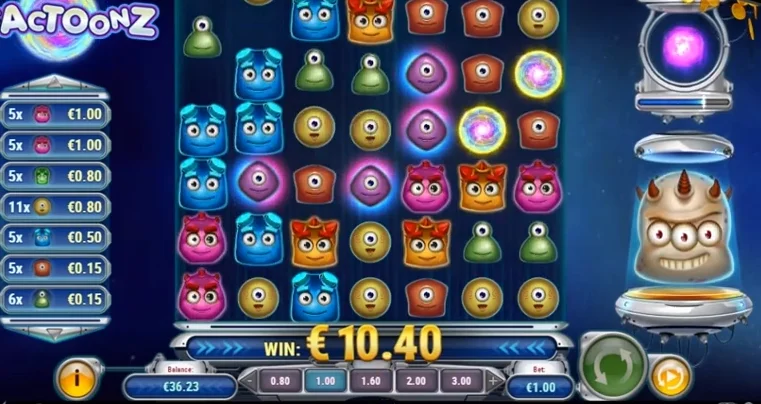
The stake does not change RNG probabilities. Stake-size buttons sit in the bottom panel: plus and minus adjust the step, or one of five preset buttons can be chosen. After pressing Start the round runs at the fixed stake; it cannot be changed during cascades and the feature queue.
How the Payout Model Works (Mechanics Affecting RTP and Max Win)
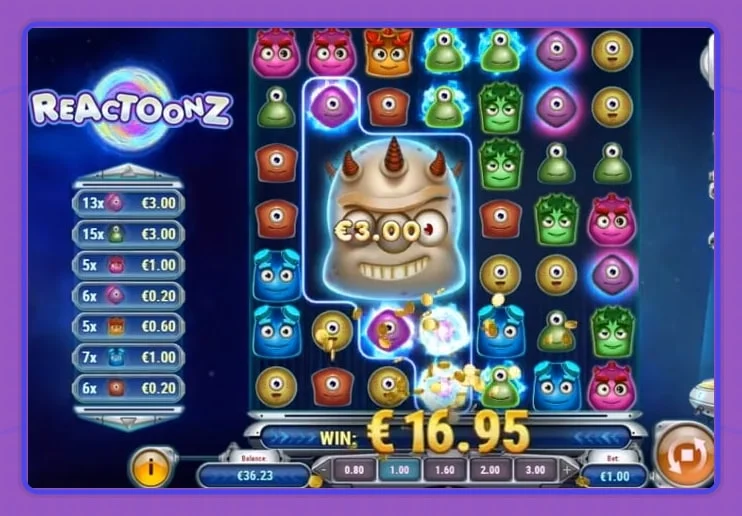
Reactoonz payout potential does not sit in a separate free-spin round. It builds inside a single game round: Reactoonz cluster payouts charge five Quantum Leap meters, Quantum feature Reactoonz line up in the queue, and once fully charged Gargantoon is added.
As long as the grid keeps forming combinations, the meters do not reset. Reset occurs only at the end of the round when no more winning clusters appear.
Cluster Payouts and Cascades on the 7×7 Grid
The playing field is 7x7. A win is awarded by a cluster of 5 or more identical symbols connected horizontally or vertically without gaps. Diagonals do not form clusters. A combination can start at any point on the grid; only the highest-value cluster of one symbol type is paid.
Winning symbols are removed and new ones drop from above. The round continues while cascades create new clusters. Multiple clusters in one drop are summed. All feature payouts are also added to the round total at its end.
Additional multipliers inside the base grid work as follows:
- 4 identical symbols in a 2x2 square become Giantoonz;
- if Giantoonz is part of a winning cluster, that cluster is doubled;
- on every spin one random one-eyed symbol type is marked as fluctuating symbol;
- if the marked symbol is part of a win, it leaves 2 wilds behind;
- wild substitutes for regular symbols and participates in subsequent cascades.
On a starting spin with no win there is a separate chance: Gargantoon may drop 4 to 8 wilds onto the grid. This is not the full Gargantoon feature, but a targeted seeding that sometimes starts the first cascade chain.
Quantum Meter, Implosion and the Path to Gargantoon
Every win inside the round fills five Quantum Leap meters in sequence. When one meter is full, one of four features is randomly queued. Features from the queue trigger only after current cascades have stopped.
The queue composition is fixed by the rules:
- Implosion. 3-6 symbols turn into wilds and all adjacent cells are destroyed.
- Alteration. A random one-eyed symbol is chosen; all symbols of that type change to another type. If no one-eyed symbols are present, any available symbol is taken.
- Demolition. All one-eyed symbols and all symbols matching the chosen type are destroyed.
- Incision. A wild is placed in the center and two diagonals with the same random symbol are drawn across the grid.
When all 5 meters are charged, Gargantoon is added to the queue. First a 3x3 wild is placed at a random position. If cascades have ended, it splits into two 2x2 wilds, then into nine 1x1 wilds. Before each split the grid is refilled from above.
Gargantoon win grows not from a “magic multiplier” but from the area of wilds and repeated cascades. After the queue resolves the round does not end: new clusters again feed the meters and additional effects may queue in the same spin. This loop, not a single cluster, determines the win ceiling.
Realistic Win Potential vs Marketing Numbers
The 4570x figure describes the upper limit, not a typical outcome. Reaching it in one round requires long cascades, full charging of all five meters, and favorable positioning of a large Gargantoon relative to paying symbols. The frequency of Reactoonz wins from small clusters is higher than the frequency of a full queue; therefore the slot can appear “dry” for a long time at the same RTP.
Stake size and time of day do not shift probability. Hyper Spin (holding Space for about 1.5 seconds) and the Fast Play toggle only change animation speed. Auto Play repeats the current stake up to the set limits or until the balance is insufficient; it does not affect round math.
What a session usually shows instead of the ceiling:
- short cascades without filling all five meters;
- one or two Quantum features and the queue stops;
- average Gargantoon scenario that delivers a noticeable but far-from-4570x multiplier;
- long cold streak that does not mean “the slot owes”;
- illusion of a hot series: past spins do not change the next RNG.
Realistic expectations are better built around session potential: a rare strong round either covers a series of blanks or it does not. This is a direct consequence of high variance, not a sign of a faulty client. Provider fairness here reduces to the fact that every spin result is independent; the meter cannot be “warmed up” by choosing the hour.
Practical Conclusions for the Experienced Player
The practical question is not whether “the slot can pay,” but whether the bankroll survives the gaps between full charges. High-RTP Play n Go slots with a cluster model are often built the same way: return sits in the tail of the distribution, not in steady small payouts.
Below are only model limitations, without “how to trigger” schemes. Any bet sequence remains a bet against the same RNG.
Bankroll and Stake Selection for This Volatility
Bankroll management here is needed not to raise the chance, but to ensure a series of empty spins does not wipe the balance before the first complete Quantum cycle. The higher the stake relative to the deposit, the fewer rounds remain available while waiting for the rare tail.
The client has Auto adjust bet: if the balance is insufficient for the current level, the stake is automatically lowered to the nearest available amount and does not return to the original after a win. This is convenient for continuing auto-spins but breaks any pre-calculated stake size.
| If bankroll roughly equals | Practical effect of high volatility | What to watch in the interface |
|---|---|---|
| 50-80 stakes | High risk of ending the session before meters are fully queued | Current plus/minus step and five stake buttons |
| 100-200 stakes | Higher chance of seeing several Quantum events | Paytable: RTP of the specific build |
| 200+ stakes | Distance closer to the point where RTP becomes meaningful to discuss | Auto Play limits and stop on low balance |
A typical mistake is raising the stake after a losing streak “to catch up the meter.” Meters exist only inside the current round and reset at its end. Another mistake is reading a Hyper Spin animation pause as a sign of an imminent feature: acceleration simply slows if the feature has already triggered.
Comparison with Reactoonz 2 and Other Play’n GO Slots
Comparison with Reactoonz 2 makes sense only on round economics, not on characters. The original has no separate bonus buy and no classic free spins: all potential sits in cascades, five meters and Gargantoon. The second part uses a different feature scheme and a different stated ceiling; RTP and max-win figures must be checked in its own paytable rather than carrying over 96.51% and 4570x.
Other Play'n GO cluster slots on a dropping-symbols grid are often simpler to read: a large part of their return is tied to a separate bonus mode. Reactoonz keeps tension inside a single spin. To decide “play this or the neighboring cluster slot,” three points in the client are enough.
- RTP line in the paytable of this site, not a remembered review figure.
- Stated ceiling in stake multipliers.
- Whether a buy-in to the feature exists: Reactoonz has none, so distance is only through regular spins.
If a more even win frequency is desired, the original’s math is usually less suitable than a low- or medium-variance slot. If the tail of the distribution inside one round is specifically wanted, the Reactoonz model delivers it through the queue, not through round purchases.

Mason Keller
Mason Keller reviews real-money slots with a sharp focus on cascade math, bonus structures, and licensed operators. He dissects Reactoonz cluster pays, Gargantoon quantum features, and free-spin rounds to give players clear, evidence-based guidance. His editorial work turns technical details into practical casino recommendations that prioritize fair play and verified bonuses.